A Man Named Dungar Singh. And a Wind Turbine That Could End Your Electricity Bill for 20 Years.
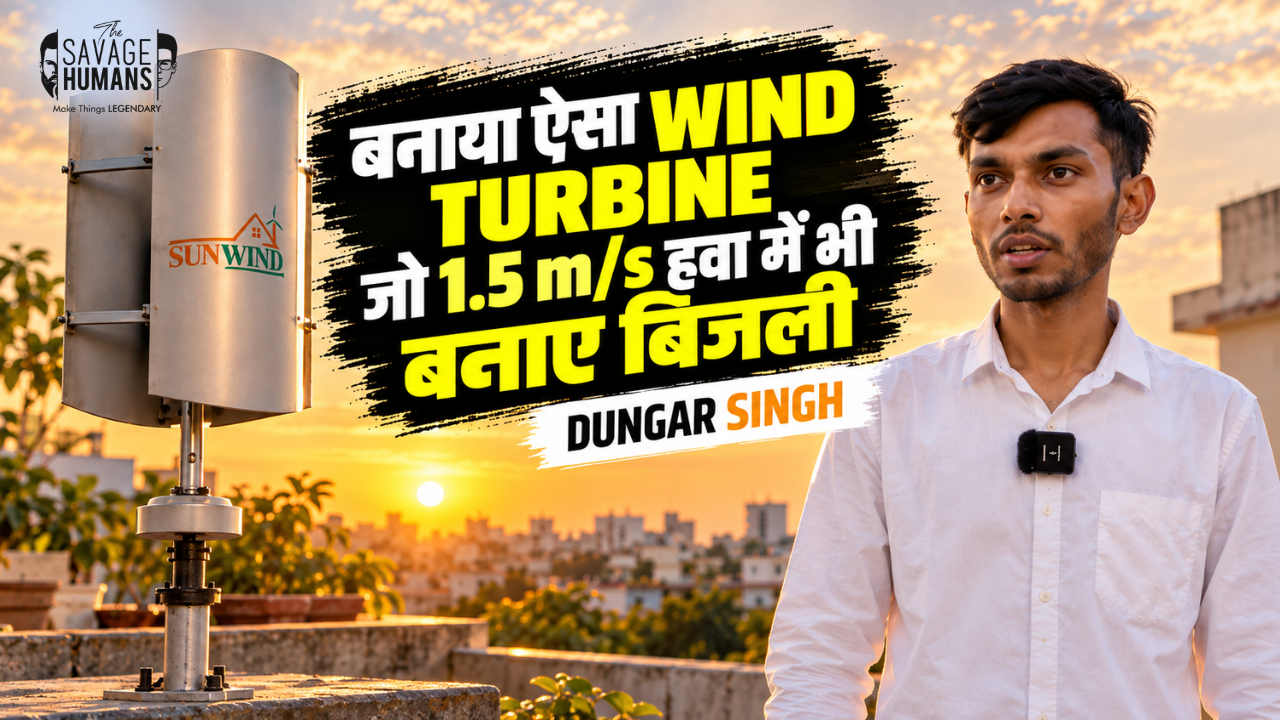
Barmer, Rajasthan.
If you have ever driven through the Thar Desert, you know this landscape — vast, dry, relentlessly sun-baked, and swept by winds that seem to come from nowhere and go everywhere at once. It is one of the most resource-scarce regions in India by conventional measures. Poor soil. Extreme heat. Limited water.
But wind? Barmer has wind in abundance.
Dungar Singh grew up knowing this. And instead of accepting it as just weather, he decided to turn it into electricity — permanently, portably, and practically for free.
The result is a wind turbine that can eliminate your electricity bill for the next 20 years. Built not in a corporate R&D lab, not funded by a government grant, but thought up and developed by a man from a small village in one of India’s most remote districts.
His innovation is now gaining national attention through Sunwind — and it deserves every bit of it.
Who Is Dungar Singh?
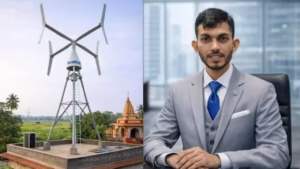
Dungar Singh is not an IIT graduate. He does not have a LinkedIn profile with impressive designations. He is a man from Barmer — a district that most urban Indians would struggle to find on a map — who looked at the wind blowing across his village every single day and asked a question that most of us never think to ask:
Why aren’t we using this?
That question, taken seriously and followed through with years of work, became a wind turbine that is now changing how people think about rural energy in India.
His story is not just about technology. It is about the kind of problem-solving that happens when someone is close enough to a problem to feel it personally — and stubborn enough to actually fix it.
What Makes This Turbine Different
India has seen wind energy before. Large wind farms dot the coastlines of Tamil Nadu and Gujarat. But those are industrial-scale installations — massive, expensive, immovable, and completely out of reach for the average household.
Dungar Singh’s turbine is none of those things.
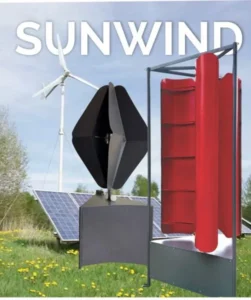
Here is what makes it stand apart:
It works in almost no wind at all. Most small wind turbines require wind speeds of 3 to 4 metres per second before they start generating meaningful power. Dungar Singh’s turbine begins generating electricity at just 1.5 m/s — a gentle breeze, barely enough to rustle leaves. In a country where wind patterns are inconsistent and often mild, especially inland, this is a critical advantage.
It generates serious power. The turbine produces 8 to 10 units of electricity — enough to run fans, lights, a television, a phone charging station, and other everyday electronics without interruption. For a rural household, this is not supplementary power. This is complete energy independence.
It matches the output of a 2kW solar system. Solar panels have become the default conversation around clean rural energy. A 2kW solar system is considered a solid, reliable setup for a small household. Dungar Singh’s 1kW turbine matches that output — often exceeding it during cloudy days or at night when solar panels go dark but the wind keeps blowing.
It is portable. This is perhaps the most underappreciated feature. Large wind installations are permanent infrastructure. Dungar Singh’s turbine can be moved — making it viable for farmers who work across different land parcels, for temporary setups at events or construction sites, or for disaster relief and remote deployment where grid connectivity is absent.
It lasts 20 years. The lifecycle of this turbine is two decades of functional electricity generation. For a household that installs it today, that means 20 years of zero electricity bills. The return on investment is not just financially significant — it is transformational for families living on tight margins where every rupee of the monthly electricity bill is a genuine burden.
The Energy Problem Nobody Explains Clearly Enough
India’s electricity story is often told in one of two ways — either as a success narrative about how far rural electrification has come, or as a policy debate about renewable targets and grid infrastructure.
Both miss something important.
Electrification and reliable electricity are not the same thing. Millions of Indian homes have connections to the grid but still face hours of daily power cuts. Many rural households in states like Rajasthan, Bihar, Uttar Pradesh, and Jharkhand receive power for only a few hours a day — sometimes less. For these families, being “electrified” on paper does not mean having functional, dependable electricity in practice.
At the same time, electricity prices in India have risen steadily. The average household power tariff has increased significantly over the past decade, and the trajectory is unlikely to reverse. For families earning ₹10,000 to ₹20,000 a month, an electricity bill of ₹500 to ₹1,500 is not a small line item. It is a meaningful portion of household income.
Decentralised, off-grid energy solutions — like Dungar Singh’s turbine — address both problems at once. They do not depend on grid reliability. And once installed, they eliminate the monthly bill entirely.
This is not a futuristic vision. It is already running in Barmer.
Why Wind Deserves More Attention Than It Gets
In the current clean energy conversation in India, solar dominates. And reasonably so — solar panel costs have dropped dramatically, government subsidies make them accessible, and rooftop solar has become genuinely mainstream in urban areas.
But solar has a fundamental limitation: it only works when the sun is shining.
Wind does not have that limitation. Wind blows at night. Wind blows on cloudy days. Wind blows during monsoons when solar generation drops to its lowest. In many regions of India — particularly in Rajasthan, where Dungar Singh lives — wind is not just abundant but continuous, driven by the thermal dynamics of the desert landscape.
A household that combines even a small wind turbine with a solar setup has something genuinely powerful: 24-hour clean energy coverage, across seasons, across weather conditions.
Dungar Singh’s turbine, with its ultra-low cut-in speed of 1.5 m/s, makes wind energy viable not just in coastal high-wind zones but in the inland regions where most of India’s rural population actually lives.
That is a big deal. It has just not been talked about loudly enough.
Sunwind and the Recognition That Followed
Dungar Singh’s work has found a platform through Sunwind, which has amplified his innovation and brought it to a wider audience. The response has been significant — because the people who see it immediately understand its value.
This is not a product being sold to people who have many options. This is a solution being offered to people who have very few — families in remote villages, farmers running equipment off expensive diesel generators, communities that have been waiting for reliable electricity for decades.
When something this practical, this affordable in the long run, and this elegantly designed reaches the right audience, it does not need a marketing budget. It spreads because it solves a real problem that millions of people actually have.
What Dungar Singh’s Story Really Tells Us
There is a pattern that The Savage Humans keeps finding as we dig into stories like this one.
The people solving India’s most stubborn problems are often not where you expect them. They are not in Bengaluru startup offices or IIT research departments. They are in Barmer. They are in Pune. They are in small towns and villages where the problem is not abstract — it is the thing that makes daily life harder, and they have decided that waiting for someone else to fix it is not an option.
Dungar Singh did not have access to cutting-edge materials or sophisticated manufacturing. He had the wind, a deep understanding of his environment, and the kind of practical intelligence that only comes from living close to a problem for a long time.
The result is a turbine that works better than products designed in far more resource-rich environments — because it was designed for the specific conditions of where it needed to work.
That is the genius of necessity. And it is more powerful than most people give it credit for.
The Savage Humans Take

20 years. Zero electricity bill. Starting at 1.5 m/s of wind.
Dungar Singh did not disrupt an industry. He did something quieter and more important — he gave his community a way out of a system that was quietly draining them, one electricity bill at a time.
The wind in Barmer has always been there. It just needed someone willing to do something with it.
Sunwind gave that work a name. Dungar Singh gave it a future.
Follow The Savage Humans for stories about the innovators, builders, and problem-solvers that mainstream media keeps missing.
Share this — because the people doing the most important work are often the least visible.