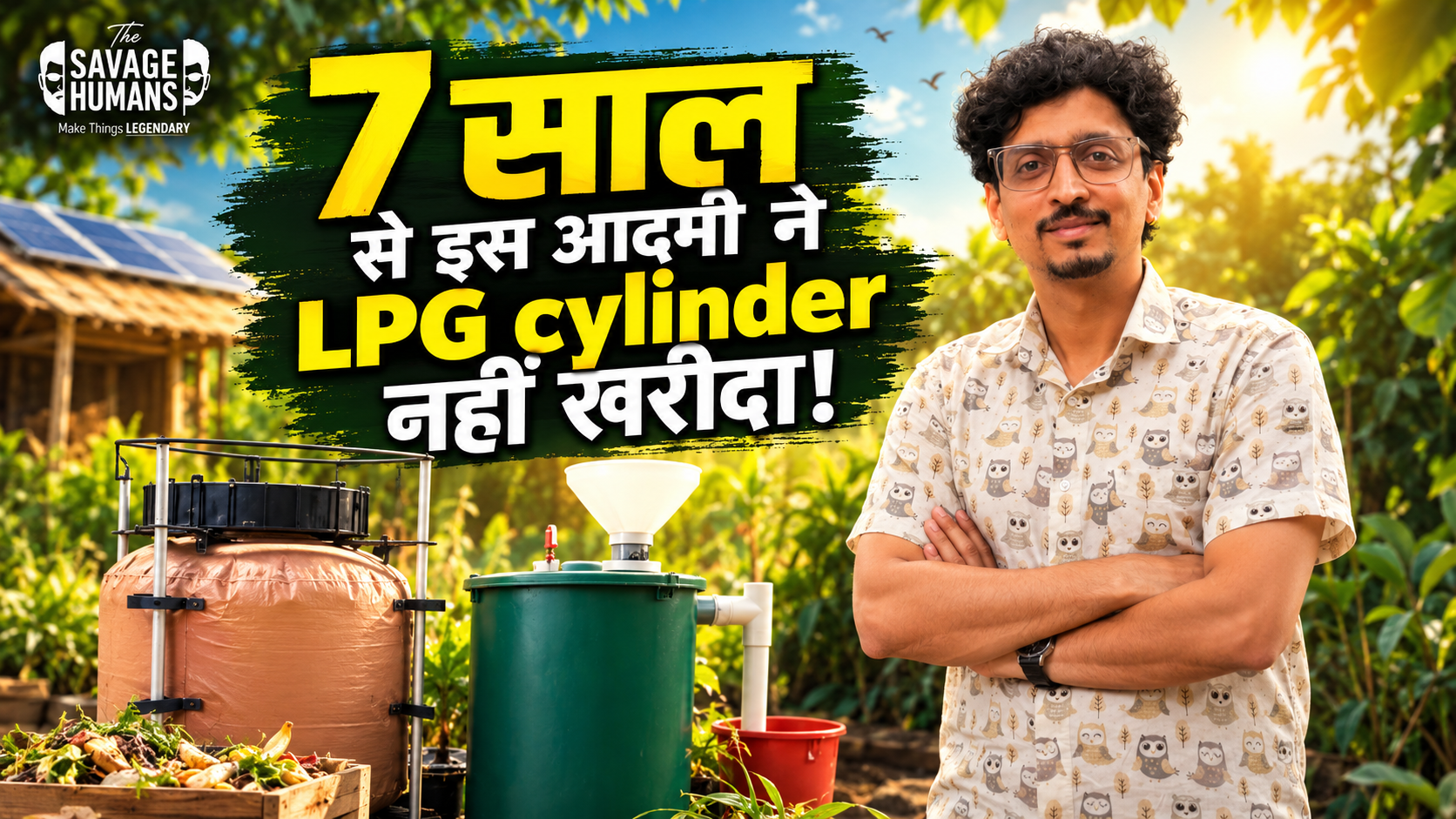
This Man Has Been Cooking for Free Since 2019 — While India Struggles for Cylinders
Every morning, across India, millions of households wake up with the same silent anxiety — is there enough gas left in the cylinder? Will the next booking come through on time? How much is the price going up this month?
Meanwhile, in Pune, a man named Priyadarshan Sahasrabuddhe lights his stove every single day — for free. No cylinder. No booking. No bill. No line.
He has been doing this since 2019.
And he is not alone.
Meet the Man Behind Vaayu Mitra
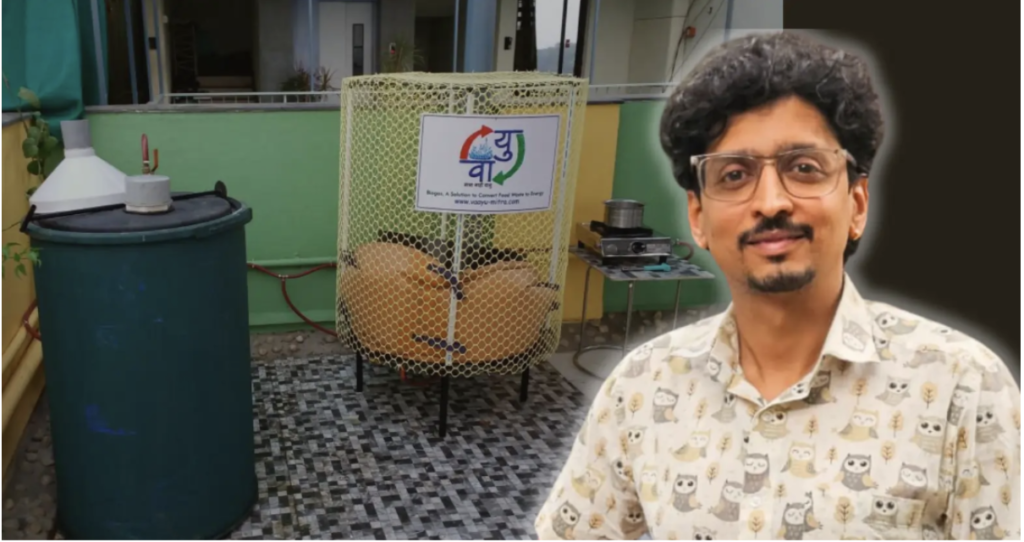
Priyadarshan Sahasrabuddhe is not a scientist working out of a government lab. He is not backed by a billion-dollar startup. He is an engineer — the kind India produces by the millions — but with a mindset that most people never develop: the ability to look at what everyone else throws away, and see energy.
He founded Vaayu Mitra, a Pune-based initiative that converts everyday kitchen waste into usable cooking gas. The concept is rooted in biogas technology — not new in itself — but the way Priyadarshan brought it into real homes, real kitchens, and real lives is what makes the story worth telling.
The name says it all. Vaayu — air, gas, life force. Mitra — friend. Vaayu Mitra is, quite literally, a friend that gives you gas for free.
What Is Kitchen Waste Biogas — And Why Aren’t We All Doing This?
Biogas is produced when organic waste — vegetable peels, leftover food, fruit scraps — breaks down in the absence of oxygen. This process, called anaerobic digestion, releases methane gas that can be directly used for cooking. The science is simple. The technology has existed for decades. Community-level biogas plants have been running in parts of rural India for years.
So why isn’t every home doing this?
Because the gap between “it works at scale” and “it works in your kitchen” is enormous. Most biogas systems require large setups, significant space, and technical maintenance that the average urban household simply cannot manage. The idea sounds good in a seminar. It rarely survives contact with a 2BHK apartment.
That is exactly the gap Priyadarshan set out to close.
Vaayu Mitra designed compact, household-level biogas units that fit the reality of Indian homes — not just farmhouses or rural communities, but urban neighbourhoods in Pune. The setup converts daily kitchen waste into enough cooking gas to meaningfully reduce — and in many cases, fully replace — LPG cylinder dependency.
The waste you were going to throw in the bin? That is your fuel.
The Numbers That Make You Stop and Think
Since Priyadarshan began this work in 2019, Vaayu Mitra has touched more than 350 households.
Across those homes, the collective impact adds up to over 950 LPG cylinders saved.
950 cylinders. Think about that for a moment — not just in terms of money, though the savings are real and significant for working-class families. Think about 950 fewer steel cylinders that needed to be produced, transported, tracked, and refilled. Think about 950 cylinders’ worth of LPG that did not need to be imported, subsidised, or burned in a way that contributes to carbon emissions.
For individual families, the math is immediate and personal. An LPG cylinder in India currently costs anywhere between ₹800 to ₹950 in most cities, and prices have only moved upward in recent years. A household using one cylinder per month spends upward of ₹10,000 a year on cooking gas alone. Vaayu Mitra users are spending close to zero.
And the global community noticed.
Priyadarshan Sahasrabuddhe and Vaayu Mitra have received international recognition for this work — a global award that affirmed what 350 Pune households already knew from experience: this works, it matters, and it deserves to scale.
The Bigger Problem Nobody Talks About Loud Enough
India’s relationship with LPG is complicated.
The Ujjwala Yojana scheme brought cooking gas connections to millions of homes below the poverty line — a genuine achievement. But connection is not the same as sustained use. The cost of refilling cylinders has made it difficult for low-income families to actually keep using LPG regularly. Many households that received connections under government schemes have since gone back to traditional, more polluting cooking methods because they simply cannot afford the refills.
At the same time, India remains significantly dependent on LPG imports. Any global supply disruption — and we have seen several in recent years — sends domestic prices climbing. The middle class feels it. The lower-middle class feels it more. And the urban poor feel it the worst.
Biogas at the household level does not solve all of this overnight. But it points toward a future where energy for cooking does not have to be imported, subsidised, and anxiously tracked. A future where what you generate at home powers your home.
Priyadarshan understood this not as an abstract environmental argument, but as a practical, immediate solution for real families.
What “Waste” Really Means
There is a reframe at the heart of Vaayu Mitra that is deceptively simple but genuinely powerful.
We are trained to think of kitchen waste as garbage — something to be managed, disposed of, and ideally kept out of sight. The vegetable peels, the leftover dal, the fruit rinds — these are problems to be solved. We tie them up in a plastic bag and hand them to the waste collection system, hoping they end up somewhere we don’t have to think about.
Priyadarshan looked at the same material and saw stored energy.
This is not a metaphor. It is chemistry. And when you act on it — when you build a system that captures that energy instead of sending it to a landfill — you get free cooking gas. You also get organic fertiliser as a byproduct, which can go back into kitchen gardens or be shared with local farmers.
The waste was never really waste. It was just energy that nobody had built a pipeline for yet.
Vaayu Mitra built that pipeline. One household at a time, starting in 2019, continuing today.
Why This Story Belongs in Your Feed Right Now
We are at a moment in India where energy is political, personal, and economic all at once. Cylinder prices, cooking costs, and kitchen anxiety are not abstract policy issues — they are daily realities in crores of homes.
Stories like Priyadarshan’s matter right now because they offer something different from the usual narrative: not a complaint about the problem, and not a promise from a large institution — but a working solution, already running in 350 homes, that emerged from one engineer’s refusal to accept that the status quo was the only option.
This is not a technology waiting for funding. It is not a pilot project waiting for government approval. It is already happening. The only thing it is waiting for is more people who know about it.
The Savage Humans Take
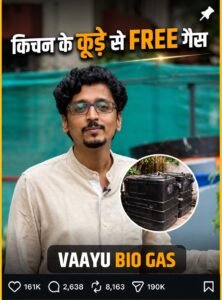
At The Savage Humans, we tell stories about people who solve real problems in ways that deserve far more attention than they get. Priyadarshan Sahasrabuddhe is exactly that kind of person.
He did not wait for a policy change. He did not start a podcast about the LPG crisis. He built something, put it in 350 homes, saved nearly 1,000 cylinders, and won a global award — all while most of us were arguing about prices on Twitter.
The real energy crisis is not in our gas lines. It is in our inability to see what is already in front of us.
Priyadarshan saw it. In kitchen waste, of all places.
And since 2019, his stove has never gone cold.
Follow The Savage Humans for more stories about people doing extraordinary things in ordinary places.
Share this with someone who needs to hear that solutions exist.