They Built a Device That Makes Rainwater Harvesting Effortless and Saved Millions of Borewells in the Process
Every monsoon season, India receives enough rainfall to meet its water needs many times over.
And every monsoon season, most of that water runs off into drains, floods streets, and disappears — while borewells across the country sink deeper, aquifers shrink, and millions of families watch their groundwater supply slowly die.
The problem is not that India lacks water. The problem is that we have never been very good at holding on to it.
Amit Doshi decided to fix that.
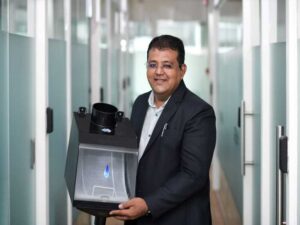
Not with a government scheme. Not with a large infrastructure project. With a device — compact, innovative, and deployable at the individual household or building level — that makes rainwater harvesting genuinely simple for the first time.
His creation, Neerain, is now helping crores of people across India do what should have always been easy: catch the rain before it disappears, and send it back into the ground where it belongs.
The Savage Humans salutes him. And this is his story.
The Crisis Hiding in Plain Sight
Before we talk about the solution, we need to talk honestly about the problem — because most people do not feel its full weight until it is too late.
India is one of the most water-stressed countries in the world. This is not a future projection. It is the present reality. The country holds about 18% of the world’s population but only about 4% of its freshwater resources. Demand has been outpacing supply for decades.
Groundwater is where most of India’s water crisis actually lives. Around 60% of India’s irrigation needs and over 80% of rural drinking water comes from groundwater — primarily through borewells and handpumps. For hundreds of millions of people, the borewell is not a convenience. It is survival.
But borewells depend on aquifers — underground water reserves that are recharged naturally by rainwater seeping through the soil. And those aquifers are being depleted faster than they can recover.
The reason is straightforward: urbanisation, concretisation, and the loss of permeable land surfaces mean that rainwater no longer seeps into the ground the way it once did. It falls on roads, rooftops, and paved surfaces — and runs away. The aquifer gets no recharge. The borewell goes deeper. Eventually, it runs dry.
This is happening in cities. It is happening in villages. It is happening in places that still receive adequate rainfall every year but are running out of groundwater anyway — because the rain falls and leaves without being absorbed.
Rainwater harvesting is the obvious answer. It has been the obvious answer for decades. So why hasn’t it scaled?
The Real Reason Rainwater Harvesting Never Took Off
Ask most people about rainwater harvesting and they will nod along — yes, good idea, very important, should be done.
Ask them if they have done it at their home or building, and the answer is almost always no.
The reason is not indifference. It is complexity.
Traditional rainwater harvesting systems require significant civil work — digging pits, building filtration chambers, laying pipelines, connecting to recharge structures. For a large housing society or an institutional building, this can cost lakhs of rupees and require weeks of construction. For an individual homeowner or a small commercial building, the cost and effort make it a non-starter.
There is also the maintenance problem. Conventional systems require regular cleaning to prevent clogging and contamination. In practice, most installed systems are poorly maintained and stop functioning effectively within a few years.
The result is a situation where everyone agrees rainwater harvesting is important, and almost nobody actually does it — because the gap between intention and execution is too wide, too expensive, and too complicated.
Amit Doshi understood this gap. And he built something to close it.
What Neerain Actually Does
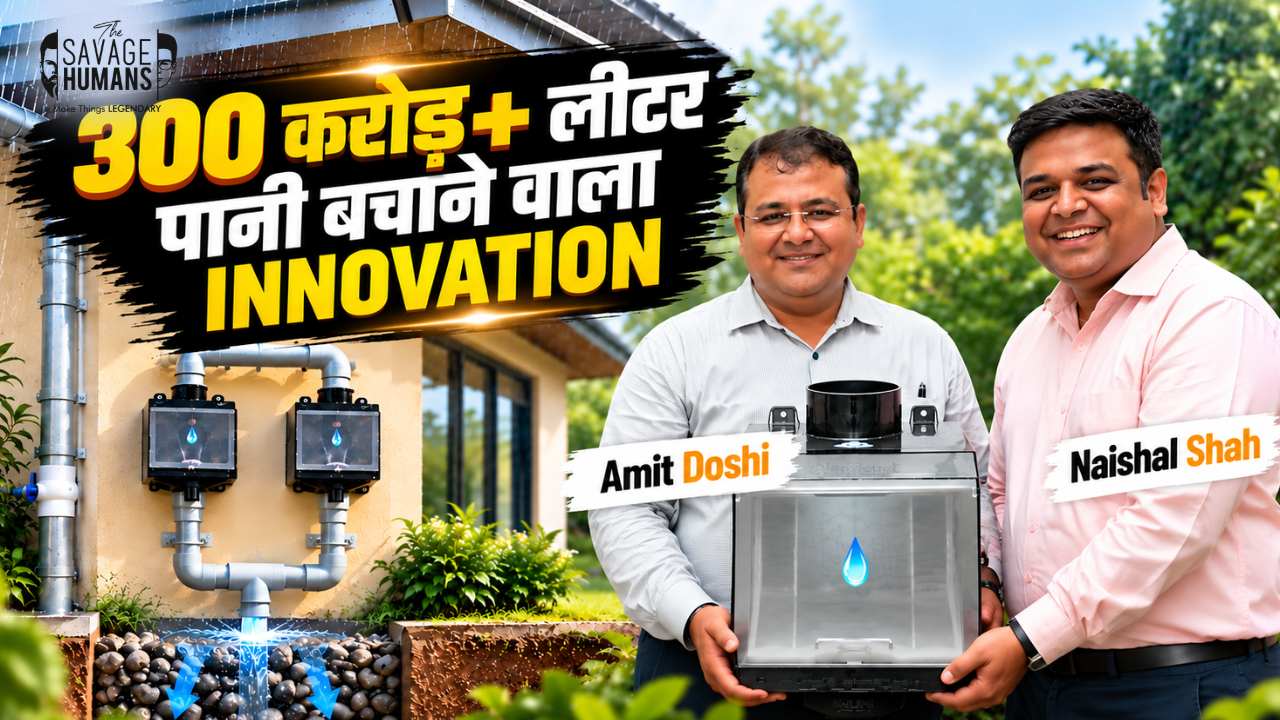
Amit Doshi’s device — Neerain — is a rainwater harvesting solution designed from the ground up to be simple, effective, and accessible.
The core insight behind Neerain is elegant: the biggest barrier to rainwater harvesting is not the cost of the water or the availability of rain — it is the friction involved in capturing it. Remove the friction, and people will harvest rainwater. Keep it complicated, and they won’t.
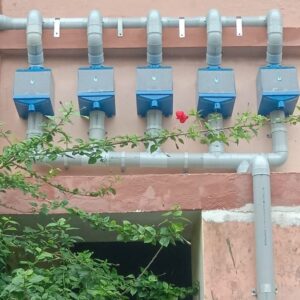
Neerain works by capturing rooftop rainwater — the most accessible and cleanest form of harvestable water — and directing it efficiently into the ground, directly recharging the aquifer below. The device handles filtration and channelling in a way that requires minimal infrastructure, minimal civil work, and minimal ongoing maintenance.
For homeowners, apartment buildings, offices, schools, and commercial establishments, Neerain makes it genuinely practical to participate in groundwater recharge — not as a one-time civil project but as an ongoing, functioning system that works every time it rains.
And when enough buildings in a neighbourhood do this, the cumulative effect on local groundwater levels is significant. Borewells that were going dry begin to recover. Water tables that had been dropping stabilise. Communities that were facing water scarcity start to see relief.
This is not a small thing. This is what solutions look like when they are designed for the real world rather than for a policy document.
Borewells, Aquifers, and Why This Device Matters at Scale
To understand why Neerain matters beyond individual households, you need to understand how aquifer recharge actually works.
Groundwater does not exist in underground lakes or rivers that you can tap with a single borewell. It exists in aquifers — layers of permeable rock, sand, and soil that hold water like a sponge. When rain falls and seeps through the ground, it replenishes this sponge. When we extract groundwater faster than rain replenishes it, the sponge dries out.
The key word is seeps. Rainwater has to actually enter the ground to recharge an aquifer. On a rooftop, it cannot. On a paved road, it cannot. In a concrete drain, it cannot. It needs a permeable surface — or an artificial pathway that directs it underground.
That pathway is exactly what Neerain provides.
Every building that installs Neerain becomes a recharge point — a small but real contribution to the aquifer beneath it. Multiply that across hundreds and thousands of buildings in a city, and the cumulative impact on local groundwater is transformational.
This is why Amit Doshi’s work has the potential to help crores of people. Not because one device can solve India’s water crisis alone — but because the device makes it possible for millions of individual buildings to become part of the solution, without requiring them to invest enormous effort or money to do so.
The scale of impact is determined by the simplicity of adoption. And Neerain got the simplicity right.
Amit Doshi and the Problem-Solver’s Mindset
What kind of person builds something like this?
Not someone looking for a shortcut. Developing a device that genuinely works — that handles filtration reliably, that integrates with existing infrastructure, that performs through multiple monsoon seasons without failing — takes years of iteration, testing, and refinement. It takes the willingness to go back to the drawing board when something does not work the way it should.
Amit Doshi is the kind of innovator who starts with a problem that affects millions of people and works backwards from it — asking not “what is technically possible” but “what will actually be used.” That question leads to very different design decisions. It leads to simplicity over sophistication, durability over elegance, and real-world performance over controlled-environment metrics.
The result is a product that works in the messy, inconsistent conditions of actual Indian buildings — varied rooftop sizes, varying rainfall intensities, varying soil conditions — rather than only in ideal scenarios.
That is harder than it sounds. Most innovations that look simple from the outside are the product of enormous complexity worked through and resolved behind the scenes.
Water Is the Next Crisis. This Is Part of the Answer.
India’s water situation is going to get harder before it gets easier.
Climate change is making monsoons less predictable — more intense in some regions, more erratic in others. Urban populations are growing, and urban water demand is rising faster than supply. Groundwater levels in major cities have already crossed into crisis territory in many areas. Cities like Chennai, Bengaluru, and Jaipur have experienced acute water shortages in recent years that are not anomalies — they are previews.
In this context, rainwater harvesting is not a supplementary green initiative. It is a necessity. And the technology that makes it accessible at the individual level — technology like Neerain — is not a nice-to-have. It is critical infrastructure for the next generation of Indian cities and towns.
Amit Doshi built that infrastructure in a device that fits in a building’s drainage system. The scale of the problem demanded a solution. He delivered one.
The Savage Humans Take
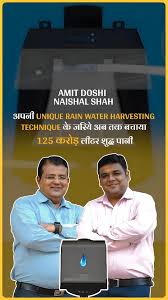
Crores of people. Borewells saved. Rain caught before it could escape.
Amit Doshi did not wait for a river interlinking project or a national water grid. He built something that a homeowner could install, a school could adopt, an apartment society could implement — and that would quietly, reliably do its job every single time it rained.
The crisis was always visible. The solution was always possible. What was missing was someone who cared enough to build the bridge between the two.
Neerain is that bridge.
The Savage Humans salutes Amit Doshi — for understanding that the most powerful solutions are the ones simple enough for everyone to use.
Water is life. And he decided it was worth fighting for.
Follow The Savage Humans for stories about the builders, innovators, and quiet heroes that India needs to know about.
Share this — because water is everyone’s problem, and this is everyone’s solution.